
Spinal Cord Injury In Children: Unique Biomechanics Require Specialized Legal Knowledge

Acute spinal cord injury (SCI) is a common cause of permanent disability and death in children and adults. 44% of SCIs are caused by car accidents. Nearly 10 percent of new SCIs in the United States occur in children ages 1 to 15. In children under 8 years of age, spinal cord injuries are most often located in the cervical spine (the neck).

Children are not just miniature adults. Their anatomy and biomechanics are unique. This is nowhere more true than in the cervical spine.

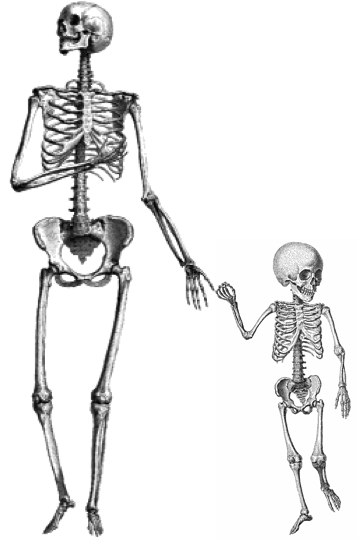
Some of the differences between adult and child anatomy can be seen in the following illustration:

Adult-and-child-skeletons

Children have a disproportionately larger head, underdeveloped neck muscles, and a much more flexible spinal column. Yet the increased flexibility of a child’s spinal column (when compared to an adult) does not proportionately apply to their spinal cord. A child’s spinal column has up to 2 inches of “play”, while the spinal cord has more like a mere quarter inch.

This unique anatomical feature in children means that in a motor vehicle accident the spinal column may flex in one or more directions that exceeds the flexibility of the child’s spinal cord. This can cause grave injury.

Because of these anatomical differences, a child’s neck is likely to be more injured than an adult’s when the same forces are applied. Some of the most common injuries to the spine in children are: facet dislocations, posterior ligament injuries, and wedge compression fractures.

So how does the unique spinal anatomy of children affect your injury claim? It’s all about biomechanics. Biomechanics, in the legal arena, refers to the proof of the mechanism of injury (what factors, what forces, what objects caused the injury and how?) It is imperative that your attorney have an understanding of both the unique anatomy and biomechanics that affect your child’s injury claim.

Without this specialized understanding, your child’s claim will suffer. This is such important knowledge because many insurance companies deny or seek to minimize the impact of an injury on a young child. They argue that the children are more resilient than adults and can be expected to “bounce back” more quickly. They deny the unique vulnerability of the child’s body to injury. Your attorney must have the specialized knowledge to disabuse the insurer of those misconceptions. 

Children are not just miniature adults. Their spines differ considerably from adults. Children are susceptible to a different spectrum of injuries, some of which can be devastating because they occur most often in the upper cervical spine.

Please call me or another qualified child injury attorney if you need help with your child’s injury claim.

Sources:

National Spinal Cord Injury Association / Pediatric Spine – Not Just Smaller – Different / Injury Mechanisms in the Pediatric Cervical Spine During Out-of-Position Airbag Deployments

———————————

Attorney Pete Pearson practices personal injury law in Atlanta, Georgia and has a special interest in helping families of injured children. He is a father to six and lives with his wife and children in Conyers, Georgia. He can be reached directly at Six-Seven-Eight 358-2564. 

Legal Claims for Wrongful Adoption in Georgia

What do you do when an adoption agency lies or misrepresents the background of a child in order to get you to adopt them and later you discover the child has health or behavioral conditions that present significant financial and emotional challenges for your family? Is there a legal solution?

I love adoptions, I love adoptive families. When I meet a family that has adopted children, I smile and get happy inside. Adoption is precious and there is something transcendent about it. It goes against our native selfishness. It is a miracle of love.

Many adoptions end well. Many adoption agencies are staffed by loving and conscientious people who want only the best for the adoptive child and new family.

But in some adoptions parents are not given vital background information about the child they bring into their family. Some families are told one thing only to find out later they were lied to and misled.

If you are one of those families – this post is for you.

Let me sketch out what I plan to talk about before I get into it.

First, I will help you understand the law of Wrongful Adoption. Wrongful Adoption law is an emerging area in our legal system. Prior to 1986 no law court had even recognized a basis in the law for a Wrongful Adoption claim. So we are somewhat in uncharted legal waters.

Second, I will provide tips about litigation challenges in the Wrongful Adoption context. I think you will find this information helpful as you try to assess whether you have a viable claim.

Third, I will clarify that what I believe Wrongful Adoptions cases are not about. I believe in once adopted, always adopted. Wrongful Adoption claims are not about undoing the adoption. Once a child is embraced by a family they become a permanent part of that family. Wrongful Adoption claims shouldn’t divorce a child from the family; they should empower families with the financial resources to provide for adopted children who turn out to have special needs.

So first – what exactly have the law courts recognized in the Wrongful Adoption context?

Wrongful Adoption is a legal claim based upon, as its name implies, a wrong. The adoptive parents (at some point in time after the adoption is completed) discover that they were wronged by adoption agencies that failed to provide them with their child’s full background information and that in failing to disclose (or misrepresenting facts about the child), the agency deprived the parents of the chance to make an informed decision as to whether to proceed with the adoption. In addition, the parents must show that they suffered harm as a result, that is, they suffered financially, physically, or emotionally.

A typical example would be a child whose parents adopt him after being told he had been in and out of foster homes, but the parents were not given access to his full records and could not have imagined all the cruelties buried in his past. In the first few months following the adoption, the child begins acting out. He may become literally uncontrollable, ruining his parents’ home and frequently accosting his siblings. Eventually everyone agrees he needs intervention but the care he needs costs hundreds of dollars every month, leaving the parents unable to pay their mortgage and in fear for the economic welfare of their other children. Should the parents be left to fend for themselves?

In response to lawsuits filed by families like the one I just described, courts have recognized a duty to disclose known relevant information about a child’s health and social background to prospective adoptive families. In the face of a breach of this duty to disclose, courts have held agencies liable for Wrongful Adoption and awarded adoptive families monetary compensation.

What do you have to be able to prove in order to win a Wrongful Adoption case? In the first case to recognize this type of legal claim in the United States, Burr v. Board of County Com’rs of Stark County, 23 Ohio St. 3d 69, 491 N.e.2d 1101, 56 A.L.R.4th 357 (1986), the court relied upon the common law elements of fraud.

The elements listed by the Burr court were:

(a)   a representation or, where there is a duty to disclose, concealment of a fact,

(b)   which is material to the transaction at hand,

(c)   made falsely, with knowledge of its falsity or with such utter disregard and recklessness as to whether it is true or false that knowledge may be inferred,

(d)          with the intent of misleading another into relying upon it,

(e)          justifiable reliance upon the representation or concealment, and

(f)           a resulting injury proximately caused by the reliance.

The Burr elements concern what we lawyers call the tort of Wrongful Adoption. A tort is simply a civil (as opposed to criminal) wrong. But a tort claim is not your exclusive remedy. Other courts have recognized that a family that is wronged by a deceptive adoption agency may have other legal grounds to sue.

For example, here in Georgia, there is the case of Cesnik v. Edgewood Baptist Church, 88 F.3d 902 (C.A.11 (Ga.), 1996). In the Cesnik case the court allowed a breach of contract action in the Wrongful Adoption context. The Cesnik case also allowed the wronged family to maintain federal and Georgia RICO claims. RICO claims can be extremely effective in holding adoption agencies accountable since the RICO statutes allow not only for compensatory damages caused by the misconduct but also treble damages, punitive damages, attorney fees and expenses of litigation.

Moving to my second point – litigation obstacles in the Wrongful Adoption context.

Potential Obstacle # 1 –

These cases sometimes involve abused or neglected children who have been placed in foster care through government agencies. Private adoption agencies seeking to place these children may not be aware of everything that happened in foster care because of insufficient communication between state caseworkers and the private agencies.

In some cases where the state caseworker fails to get all the records or deliver them or, in some cases, the worker decides it would be better for the child’s chances if certain information were omitted.

Here is the rub: state agencies are generally immune from negligence suits, so in order for you to recover there must be a legitimate way to tie in the private agency that did the placement. One way to do this is by arguing that the private agency should not have relied on the state agency or had a duty to investigate more comprehensively.

Potential Obstacle # 2 –

It is important to assess whether you damages are adequate before you start the legal process. Litigating is expensive and time consuming. Unless your damages are significant the benefits you hope to gain may be outweighed by the costs of litigation.

What kind of damages are adequate? Call me or someone like me to find out but here is a real world example of one family who brought a viable claim –

A family adopted a little boy and were told by the adoption agency that all of the medical records and other information indicated that the boy was perfectly healthy.  The family was also told the boy’s birth mother had received prenatal care since the sixth week of pregnancy and that she had not used drugs during the pregnancy. Shortly after the boy came home the family noticed he had health problems. Four to six months later the family received the boy’s medical records. The records showed that the birth mother had, in fact, received no prenatal care, that she had tested positive for opiates and barbiturates at the time of delivery, that the delivery had been complicated, and that the boy had been born prematurely. Doctors soon diagnosed the boy with cerebral palsy, asthma, developmental disorders, and severe behavioral problems. The doctors suspected that most or all of these conditions were caused by exposure to drugs and alcohol during the pregnancy and by a lack of prenatal care.

The fact of severe health and behavioral problems justifies the bringing of a legal claim.

Potential Obstacle # 3 –

Another damages related obstacle has to do with the common law rule that says parents are entitled to recover for the care of a child only until the child is 18 years old. To recover care expenses for the duration of the child’s life, parents must prove the child will never be self-supporting.

If the parents can only recover for medical expenses during the child’s minority (until he or she turns 18) this drastically reduces the amount of compensation which the family can request.

It is important to discuss with the child’s physicians whether he or she will ever be self-supporting.

Potential Obstacle # 4 –

If your child will receive any governmental benefits related to a health or behavior condition the attorneys for the adoption agency may argue that they should receive a set-off or credit for benefits provided by state and federal programs. This could reduce or eliminate the amount of compensation.

Of course there is no guarantee that a child will continue being eligible for governmental benefits. And it would unfair if the agency that lied to the family was allowed to shift the financial burden for caring for the child to taxpayers.

Potential Obstacle # 5 –

What if you signed a waiver or notice of the risk that your adoptive child would have health or behavioral problems? Does that mean you have no case?

Agencies frequently have potential adoptive parents sign a waiver of liability and notice of risk. Such waiver and notices may shield an agency from certain legal liabilities. But exercising the proper duty of care may not be contracted away by the agency. There is always grounds for challenging a waiver that excuses an agency from behaving in a prudent and reasonable manner.

My third and final point – permanency for adopted children.

One of the overarching purposes of adoption law is creating permanency and stability for children. A commitment to adopt a child is analogous to a marriage commitment. It is “until death do us part.”

As an attorney whose professional mission is to advocate for children, I will never use the emerging area of Wrongful Adoption law to undo a child’s adoption and terminate that child’s status as a part of the adoptive family.

The value and virtue of Wrongful Adoption laws is to empower adoptive families who have been deceived to provide a loving home and all support care necessary for the flourishing of the child and family.

If you think I may be able to assist you in setting things right so that your family is not financially devastated by the wrongdoing of an agency, I would love to talk with you.

Conclusion

When you adopt a child you are wholly dependent on the adoption agency to provide truthful and accurate information about the child. If that agency abuses your trust and lies or misrepresents the truth about your child’s background, they have committed a moral and legal wrong. They need to be called to account. And sometimes a lawsuit is a fitting means of accountability.

Keep in mind that as with all legal claims, certain time deadlines do exist. These are known as “statutes of limitation” and they limit how long you have to file suit. If you miss the deadline you lose all your rights with regard to that particular claim. In Cesnik v. Edgewood Baptist Church, 88 F.3d 902 (C.A.11 (Ga.), 1996), the court indicated that the deadline on Wrongful Adoption claims (at least so far as the tort claim goes) is probably 2 years from the date of the agencies wrongful acts.

————————————————–

Attorney Pete Pearson practices law in Atlanta, Georgia and has a special interest in helping families with special needs children. He is a father to six and lives with his wife and children near Atlanta, Georgia. He can be reached directly at Six-Seven-Eight 358-2564. 

Child Injury at Unlicensed or Exempt Daycare Centers in Georgia

Does it matter if the daycare center where your child was injured was unlicensed or exempt from licensure? It may matter, if you intend to bring a legal claim for your child’s injuries.

Operating a daycare center that should have a license without one is a horse of a different color than operating a daycare center that is not required to be licensed. I’m going to talk a bit about how to tell the difference between exempt and non-exempt daycare centers. And then I’ll talk about why it matters.

First off, you need to know that some Georgia daycare centers are exempt from Georgia licensing standards. The Georgia Department of Early Care and Learning (also known as Bright From The Start) promulgates regulations that govern these matters. The regulations exempt certain types of child care programs. Click on this link if you’d like to see a full copy of the exemption rules but I’ll give you a few highlights from the rules so you’ll have an idea what kinds of programs don’t have to get a license. 

The following are examples of the types of programs which are exempt from being licensed:

1. Programs which are owned and operated by any department or agency of state, county, or municipal government. So, all public schools would be included in this category of exempt daycare centers.

2. Private non-public educational programs with an established curriculum for children five (5) years and older that operate during the school term for the customary school day, as defined by Georgia law.  So, most of what we commonly refer to as “private schools” are exempt.

3. Parent’s Morning Out, Parent’s Night Out, or similar programs which operate for no more than one session of up to four (4) consecutive hours per day and which limit attendance to no more than eight (8) hours a week per child.

4. Nursery schools, playschools, kindergartens or other educational programs for children two (2) years through six (6) years of age which operate for no more than four (4) consecutive hours per day.

5. Day camp programs for children five (5) years and older that are operated between school terms, whose primary purpose is to provide organized recreational, religious, or instructional activities.

6. Short-term educational or recreational activities or classes for children in which the supervision and care of the children are incidental to their participation in the activity or training in specific subjects, such as, but not limited to, music lessons, dance classes, swim lessons, etc. The provider is not assuming responsibility for supervision and care of the children outside of the classes or activities the children’ participate in and shall not advertise or otherwise represent that child care services are offered. Note the requirement that the provider not advertise or represent they are offering child care services. If the provider does advertise or represent they are offering child care services the arguably are subject to the licensure requirements.

7. Any short-term child care service provided by an establishment, such as, but not limited to, a religious facility, health club, or retail store, and such program or service meets all of the following:

(i) Operated on the premises of the establishment;
(ii) Operated for the convenience of the parents, guardians, or custodians and for the use of on-duty employees or students attending classes;
(iii) Parents, guardians, or custodians are participating in activities provided by the establishment on the premises of the establishment;
(iv) Parents, guardians, or custodians are readily available;
(v) Attendance of child in the short-term child care service is limited to no more than four (4) hours per day and no more than ten (10) hours per week, except in the instance of child care services offered at infrequent events such as, but not limited to, conferences and weddings.

8. Programs operated after the customary school day, as defined in Georgia law, for children five (5) years and older that are strictly instructional and skill-based in a single talent, ability, expertise, proficiency or subject or in closely related skills, proficiencies or subjects, including but not limited to classes such as art, cheerleading, dance, drama, gymnastics, martial arts and music, and the programs comply with all of the following:

(i) Programs provide direct instruction in the single skill or subject and/or closely related skills or subjects to every child each day the child is present;
(ii) Programs do not provide services that are not directly related to the single skill or subject or to the closely related skills or subjects, such as but not limited to homework assistance. During the hours of operation, programs may provide services related to the instruction, such as transportation and giving children time to change into proper clothes/gear;
(iii) Programs shall not advertise or otherwise represent that the program is a child care facility, an after school program, or that the program offers child care services;
(iv) Programs shall not prepare meals and snacks, but may provide ready-to-eat snacks, such as pre-packaged snacks;
(v) The majority of the program staff responsible for instruction shall possess specialized qualifications to instruct in that skill or subject, and the program shall submit documentation of such specialized qualifications of staff to the department at the time of application for exemption or as requested by the department;
(vi) Programs shall inform parents or guardians about the physical risks a child may face while participating in the program;
(vii) Such programs shall not be an integral part of a licensed child care learning center or day care center;
(viii) Enrollment information shall clearly define the duration of the program.

9. Short term educational programs offered to school-aged children in which the supervision and care of the children are incidental to their participation in the short-term educational program, and the provider is not assuming responsibility for the provision of daily child care outside the scheduled program. The majority of staff responsible for the direct delivery of education services to children possesses specialized qualifications that are directly related to the short term educational programs being offered, and the program shall submit documentation of such specialized qualifications to the department at the time of application for exemption or as requested by the department. The sole or primary purpose of such short term educational programs is:

(i) To prepare children for advancement to the next educational level through a prescribed course of study or curriculum;
(ii) To provide specialized tutoring services through a prescribed course of study or curriculum to assist children with the passage of mandatory educational proficiency examinations;
(iii) To provide specialized tutoring services through a prescribed course of study or curriculum to assist children in specific academic areas, such as, but not limited to, foreign language, mathematics, science, etc.

10. Any program or facility providing care for school-aged children that is operated by, or in affiliation with a national membership non-profit organization that was created for the purpose of providing youth services and youth development, that charges a membership fee for children and may receive monthly, weekly, or daily fees for services. Such program or facility holds membership in good standing and is certified by its national association as complying with the association’s purposes, procedures, minimum standards and mandatory requirements. Such national membership organizations include, but are not limited to, the Boys and Girls Clubs of America.

11. Any program providing group care for children for no pay. There’s an easy one: no compensation = exempt from licensure. 

12. A center that is licensed by the department may request an exemption from licensure if the center’s program is an integral part of an established religious congregation or religious school that conducts regularly scheduled classes, courses of study, or educational programs and is a member of or accredited by or certified by a state, regional, or national accrediting agency for religious educational instruction or a state, regional, or national accrediting agency for educational instruction as recognized and approved by the department if such accrediting entity uses standards that are substantially similar to those established by the department. In addition to the requirements listed above applicable to all exemptions, the following additional requirements shall apply to centers seeking an exemption under this provision:

(i) A center seeking such exemption from licensure shall be required to submit to the department documentation of certification or accreditation, including a copy of its most recent certification or accreditation inspection report, and any other pertinent documentation as requested by the department, such as non-profit tax-exempt verification. The accrediting agency must conduct regularly scheduled visits to the center while such center remains accredited.
(ii) If such exemption is granted, the center shall submit annual documentation to the department verifying its continued certification or accreditation, including a copy of its most recent certification or accreditation inspection report, and other pertinent documentation as may be requested by the department.
(iii) Such exemptions granted by the department are valid as long as the center remains certified or accredited. The program shall provide the department written notice within five (5) business days of the center’s loss of certification or accreditation, including a copy of such notification from the certifying or accrediting entity. The department shall rescind the center’s exemption granted herein upon notification of the loss of certification or accreditation.
(iv) Any center seeking such exemption shall comply with all applicable requirements for background checks for directors/employees as required in O.C.G.A. § 20-1A-30 et seq., Chapter 591-1-1, Rules for Child Care Learning Centers, department policies, as well as applicable local, regional, and state health department, state fire marshal, and local fire prevention guidelines/requirements while such exemption is in effect. The department retains jurisdiction over centers granted such exemption to conduct unannounced periodic background check audits and to conduct complaint investigations regarding compliance with background check requirements, as well as compliance with local, regional, and state health department, state fire marshal, and local fire prevention guidelines/requirements.
(v) The department may rescind such exemption for a center’s failure to comply with the requirements for background checks for directors/employees pursuant to O.C.G.A. § 20-1A-30 et seq., Chapter 591-1-1, Rules for Child Care Learning Centers, and department policies.
(vi) Any center applying for such exemption that is owned and/or under the legal control/direction of the certifying or accrediting entity shall not be approved by the department.
(vii) A center seeking such exemption shall adopt and comply with the minimum standards of its certifying or accrediting entity for the operation of the center’s program. Such minimum standards adopted by the center shall be published and made available to parents of enrolled or prospective children upon request.
(viii) A center granted such exemption shall comply with the requirements regarding notification to parents of enrolled children if the center does not carry liability insurance.

OK, I’ll stop with the regulations that never end. Here’s my point in sharing all the detail with you: it’s complicated. It takes rigorous research to determine if a particular program that appears to be subject to licensure may in fact be entitled to an exemption. Call me or someone like me if you want to be sure.

So why may it matter to your legal claim if a daycare center is exempt? It may matter because exempt programs have a much lower level of accountability. They are not scrutinized the same way as licensed providers. The State doesn’t do the kind of inspections that are done at licensed daycare centers. And when your lawyer sets out to build your legal case against a negligent daycare provider, there won’t necessarily be any records of State inspections. And, perhaps most importantly, there may be an issue about whether the Bright From the Start regulations that pertain to child safety even apply to exempt centers. 

That does not mean we can not successfully claim against an exempt daycare center. It simply means a claim brought against an exempt daycare center must proceed along a different track than a claim against a licensed daycare center. You want to select an attorney who is 1) aware of the difference between exempt and non-exempt programs, and 2) will persevere through the detailed research required to determine which category your child’s daycare center falls into.

Now please don’t stop reading quite yet, because in many ways the most important information is still to come.

The reason why I began this post by talking about exempt daycare centers is because many folks tend to jump to the conclusion that an unlicensed daycare center is always an illegal daycare center. You know from what I’ve written above that is not the case. Many are exempt from licensure under Georgia law.

So any lawyer worth their salt is going to take the time to analyze what situation applies to you and your child’s injury claim: do we have a situation where the daycare center is required to obtain a license? Or is the program exempt? That’s an important question to ask at the start.

But let’s talk now about daycare centers that are not exempt but instead required to be licensed by the State of Georgia. Let’s assume the program in which your child was injured was such a non-exempt program but had no license. What then?

You may have a very strong case, assuming your attorney can show that the lack of licensure was causally connected to the injury your child sustained (by which I mean that the failure to obtain a license or something flowing from that failure is what caused your child to get injured.)

I have blogged elsewhere about using Georgia licensing standards for daycare centers to prove negligence. So I’m not going to discuss that again in this post. But keep in mind that even if a non-exempt daycare center neglects to get licensed, they still owed your child the duties provided for in the Georgia licensing standards.

Here is a report I found interesting on a daycare center that was recently shut down by authorities in Savannah, Georgia. It was shut down after it was discovered they were operating without a license – WJCL Looks Into Child Care Center Laws

————————————————–

Attorney Pete Pearson practices personal injury law in Atlanta, Georgia and has a special interest in helping families of injured children. He is a father to six and lives with his wife and children in Conyers, Georgia. He can be reached directly at Six-Seven-Eight 358-2564. 
Trampoline Injury Claims for Children

Trampolines were designed to be a specialized piece of training equipment for adults.

In 1945, George Nissen, a competitive gymnast, patented the modern trampoline. Nissen designed the trampoline as a training tool for acrobats and gymnasts and later promoted it for military aviator training. The recreational use of trampolines is a more recent development, driven primarily by the increased availability of cheaper trampolines sold for home use.

Even more recently, commercial trampoline parks (“jump parks”) have begun to appear around the country, including in Georgia. These parks target children with their marketing. Consider the following commercial blurb from Sky Zone Sports, which has recently opened a location in Suwanee, Georgia:

“Get ready for Sky Zone Indoor Trampoline Park, the creator of the world’s first all-trampoline, walled playing court (U.S. Patent #5,624,122) – perfect for just about any age, shape or physical ability.” ~ from Sky Zone’s website (retrieved September 28, 2012).

How safe are trampolines truly? Are they truly “perfect for just about any age, shape or physical ability?” Not according to the American Academy of Pediatrics.

The American Academy of Pediatrics (AAP) has repeatedly warned parents and anyone else who cares about child safety to keep kids off trampolines. According to an AAP report released this week, Emergency Departments across the country see nearly 100,000 injuries from trampolines each year. It’s not just at jump parks that kids get hurt; it’s at homes also.

The typical ways that children get hurt on trampolines include the following:

  • Too many children on the trampoline. Multiple users is a safety violation. If children are going to be allowed to use the trampoline at all, only one child should jump at a time. Of particular concern is when older children (or adults) are allowed on the trampoline along with younger children. Several studies have shown that approximately 3/4 of trampoline injuries occur when multiple people were using the trampoline. The smallest children were up to 14 times more likely to sustain injury relative to their heavier playmates. Also, heavier users create more rebound of the mat and springs and greater upward forces than smaller children can generate on their own. These forces must be absorbed by the falling body and can actually be greater than the forces a child would experience landing on solid ground!
  • Falls from the trampoline. This is an obvious one. What is not so intuitive is that the studies show that safety nets do not necessarily decrease the risk of children suffering falls.
  • Impact with the trampoline frame or springs. Again, surprisingly, the studies do NOT show that padding on the frames or springs necessarily decrease the risk of a child being injured.
  • Colliding with other children in mid air or on the way up or down.
  • Somersaults/flips. Neck and head injuries can easily result. Kill joy as it may sound, somersaults and flips are a bad idea for children on trampolines.

Typical injuries children sustain include:

  • Ankle injuries are the most common form of injury children sustain while jumping on a trampoline. This can range from a minor sprain up to a surgical fracture injury.
  • Head and neck injuries. These are the most serious child injuries typically seen resulting from trampoline accidents. Cervical spine injuries can be caused by falls off the trampoline but also commonly occur on the trampoline mat when failed somersaults or flips cause hyperflexion or hyperextension of the cervical spine. These injuries tend to be the most catastrophic of all trampoline injuries suffered.

Atypical (unusual) injuries children can sustain on trampolines include:

  • Trampoline-related fractures of the proximal tibia (upper part of the shin bone) have been observed in children 6 years and younger. These injuries occurred when young children were sharing the trampoline with larger individuals.
  • Manubriosternal Dislocations/Sternal Injuries (injuries involving the child’s breastbone). Sternal injuries have traditionally been described as a result of major trauma. These occur after thoracic hyperflexion injuries on the trampoline. They typically heal uneventfully; however, surgical stabilization may be necessary if pain persists.
  • Vertebral Artery Dissection (a flap like tear of the inner lining of vertebral artery, which is located in the neck and is the artery that supplies blood to the brain). The AAP report discussed above mentions several cases of vertebral artery dissection presenting 12 to 24 hours after a neck injury on a trampoline. Vertebral artery dissections are the result of abrupt cervical hyperextension and rotation. These are often devastating injuries and may produce lasting complications.
  • Atlanto-axial Subluxation (an injury where the vertebrae in the neck spine become misaligned as a result of trauma and may compress the spinal cord, leading to damage to the spinal cord and adjacent nerves. There have been 2 reported cases of trampoline-related atlanto-axial subluxation in children.

One important legal consideration with child trampoline injuries is that some homeowner’s insurance companies exclude trampoline injuries from coverage.

This is because trampolines are viewed as an “attractive nuisance” (something on a property that may entice children into harm) and therefore trampoline related claims are sometimes not covered by a standard insurance contract. Homeowners who own trampolines may have to obtain a “rider”  (a rider is a schedule or piece of paper attached to an insurance policy that provides the policyholder extra protection beyond the provisions contained in a standard insurance agreement) that expressly provides coverage for trampoline related claims.

Contacting an attorney to investigate the availability of liability insurance that could compensate you and your child for medical bills and other items of damages is advisable.

Another legal consideration if your child has been injured on a trampoline is the possibility of a product liability claim against the manufacturer of the trampoline. It has been observed that there has been a decrease in the quality of recreational trampoline equipment over the past several decades. Consider this: according to the International Trampoline Industry Association, trampolines sold in 1989 had an expected life of 10 years while the expected life of trampolines sold in 2004 was only 5 years. We are seeing a degradation in the quality of the trampolines available for the recreational market.

A legal claim against a homeowner, commercial trampoline park (“jump park”), or trampoline manufacturer may have to overcome the legal defense known as “assumption of the risk.” This defense essentially blames the victim for engaging in an activity that they knew or should have known was dangerous. The efficacy of this defense is close to nil, however, with younger children, due to another legal doctrine, known as the “tender years doctrine.” This doctrine holds that children under a certain age (probably 7) can not be charged with contributory negligence (fault) or assumption of the risk.

If your child has been hurt on a trampoline and you believe there was negligence, I would be happy to help you evaluate your claim.

————————————————–

Attorney Pete Pearson practices personal injury law in Atlanta, Georgia and has a special interest in helping families of injured children. He is a father to six and lives with his wife and children in Conyers, Georgia. He can be reached directly at Six-Seven-Eight 358-2564. 

Opening Day of Georgia Deer Hunting Season Brings With It Risk of Injury/Death To Children from Careless Gun (and Bow) Owners

The fall 2012-2013 Georgia deer hunting season opens in two days (September 8th) for bow hunters and Georgia hunters that will be hunting with firearms hit the woods on October 20th, the official open of the firearms deer season. With all the excitement over the hunt, archery and firearm safety can get lax. As I write, weapons owners are taking their bows and firearms out of their safes for cleaning in preparation for the upcoming season – and that can mean danger for children.

Many unintentional gunshot wounds and deaths occur in or nearby the home of family friends or relatives. When a child is injured by a weapon and that injury could have been prevented by the owner of the weapon or owner of the premises where the injury occurred, a careful investigation by an attorney is advisable.

In what kind of situations may the family of a child injured or killed by a gunshot or arrow seek legal help?

ANYTIME a child is injured legal relief may be available. I’ll mention a few common situations where legal liability will arise, but I will by no means exhaust the possibilities.

First off, be aware that Georgia law mandates hunter safety education for hunters before they can purchase a hunting license. I’ve been through a couple of the courses myself. Upon completion of the hunter education course, participants are given a hunter safety certificate and a Georgia Certified Safe Hunter badge like this one:

Georgia Certified Safe Hunter Badge

Anyone who has been through one of the Georgia hunter education courses has been trained how to protect children from gunshot injuries. And that training creates legal duties to any children that are in the hunter’s home or vehicle or other premise where a hunter is carrying or storing archery or firearm equipment.

One fundamental rule of firearm safety is Muzzle Control. A firearm must never be pointed at or near a human being. At all times it must be carried with the muzzle pointing away from others. Hunters are taught that even if they feel certain the firearm is unloaded they must treat it as if it is loaded and maintain Muzzle Control. Violation of this basic safety rule with injury or death resulting could form the basis for a successful injury claim.

Another firearm safety basic is that whether there are normally children in the home or not, ammunition (cartridges, shot shells) should be stored AWAY from the weapons themselves. Both live ammunition and weapons should be kept under lock and key away from children and irresponsible adults. Live ammunition can explode if played with and dropped or placed near high heat. Children should never be allowed to handle live ammunition without adult supervision. Violation of these safety rules can create a situation where a child finds a gun and ammunition together and loads and fires the weapon. At firearm owner that violates these rules with injury or death resulting is going to face legal liability.

Did you know that hunters are taught that the first thing they must always do is to check to see if a weapon is loaded? Every time they pick it up. Even if another person checks first, hunters are duty bound to double check the weapon to be sure it is unloaded as soon as it is handed to them. The first thing they should do is check the action and magazine (if one is present) to ensure no rounds are present.

Another situation that can lead to tragedy is when weapon owners get careless during target practice or plinking (or hunting). Hunters and weapon owners are legally responsible for what comes out of their weapons. One fundamental of firearm safety is to be sure of the target and what is in front of it and beyond it. If a shooter cannot see what lies beyond the target they have a duty to not take the shot. The illustration below shows one situation where the shot should not be taken due to inability of the shooter to see what lies over the hill.

If a hunter took the shot in the above illustration and someone was injured or killed as a result he would have legal liability.

I could go on and on about safety rules in the home and field. I haven’t even mentioned some of the most egregious safety violations such as hunting and handling firearms after consuming alcohol or drugs. Injuries that result from this type of violation are inexcusable and form the basis for a punitive damages claim against the offender.

If your loved one has been injured or killed in a hunting incident or in or around the home of family or friends where weapon safety rules were not followed, please call me. I understand it can be hard to know what to do when friends and family are involved and your child is hurt. Calling me does not obligate you to file suit against friends or family but it will educate you about what legal relief may be available to your child and your family.

————————————————–

Attorney Pete Pearson practices personal injury law in Atlanta, Georgia and has a special interest in helping families of injured children. He is a father to six and lives with his wife and children in Conyers, Georgia. He can be reached directly at Six-Seven-Eight 358-2564. 

Child Injury – School Bus Accidents

All around the State of Georgia our kids are heading back to school. Parents entrust their children’s lives and safety to countless school bus drivers, most of whom deserve that trust and are conscientious drivers. Nevertheless, any time a child is injured on or by a school bus, parents have a right and responsibility to find out what when wrong. Sometimes driver inattention and negligence leads to tragic accidents and child injuries.

According to the NHTSA, an average of 19 school-aged children die in school bus related traffic crashes every year. Of these 19, on average 6 of the children die as occupants of a bus and 13 die as pedestrians (getting in or off the bus). More children have been killed between the hours of 3 p.m. and 4 p.m. than any other time of day. And nearly half of those killed are our youngest school-going children, those between the ages of 5-7 years of age.

Thus while school officials will often tout the high standard of safety on school buses, life changing injuries occur all too often and deserve serious and rigorous investigation.

The dangers of school buses were freshly brought to my mind by a school bus crash that occurred last Spring just a few miles from where I live. According to ABC News, six school buses taking some 200 middle school students to Six Flags crashed in Newton County, Georgia, leaving more than 50 people injured after one school bus rear-ended another, creating a chain reaction.

School Bus drivers are required to undergo extensive training. To give you an idea of just how extensive, you might want to take a look at the School Bus Driver Training Manual used by the Georgia Department of Transportation. This manual contains a goldmine of information regarding how drivers are trained and what responsibilities local school boards owe the families of students whose children take the bus to and from school.

For instance, the manual contains detailed training instructions for how bus drivers and bus monitors should load and unload non-ambulatory wheelchair passengers. Failure to follow the delineated procedures could result in injuries to special needs students. The manual describes the duties involved in safely getting a disabled child secured in their wheel chair including preparing the lift, properly positioning the wheelchair once it is lifted onto the bus, attaching the front and rear securement straps, and attaching the lap/shoulder belts. Failure to follow any of these rules could lead to injuries.

In another section, this one on “Student Behavior Management”, the manual lists certain “interventions” by bus drivers that are prohibited by Georgia law. Corporal punishment (spanking or other intervention designed to cause pain to the student) is prohibited. So is pepper spray/mace. Also, bus drivers are warned not to discipline students while the bus is in motion.

The manual also contains a wealth of information about standards for school bus drivers on the more mundane matters of operating a school bus. Topics covered include: free-way driving, lane changes, safe backing, passing and being passed, rail road crossings, and pre and post trip bus inspections.

Also discussed in the manual is the local school board’s responsibility to do background checks on those applicants who want to be hired as school bus drivers. And after hiring a driver, the school board has a ongoing duty to send them for periodic medical exams and to do performance evaluations. If a school district fails to discharge any of these duties, and a dangerous driver is permitted to transport school children, civil liability can result for negligent hiring/retention.

My firm can represent you in the following types of injury matters:

  • School Bus Rear-End Collisions
  • School Bus Skidding Off The Road
  • School Bus Crash Involving Speeding/Reckless Driving
  • Drunk or Drug-Impaired School Bus Driver
  • School Bus Driver Who Fails to Stop Bullying (with injury to your child resulting)
  • Sexual Abuse
  • Physical Abuse
  • Failure to Safely Secure Special Needs Child
  • Improper/Non-existent/Negligent Hiring & Retention by School Board

For those interested in going a little deeper in their understanding of school bus safety, I recommend the video below. It is produced by The School Bus Safety Company and it discusses various aspects of school bus safety, focusing on the proper training of drivers. It makes the disturbing claim that there are 13,000 school bus fleets without a comprehensive safety training course.

I am available to discuss all School Bus Injuries with you.

————————————————————————

Attorney Pete Pearson practices personal injury law in Atlanta, Georgia and has a special interest in helping families of injured children. He is a father to six and lives with his wife and children in Conyers, Georgia. He can be reached directly at Six-Seven-Eight 358-2564. 

Abortion Malpractice – Failure to Comply with Parental Notification Requirements

In 2007 Georgia law was amended to modify requirements related to parental notification for unemancipated minors.

Unemancipated minors (which in this context means any female under the age of 18 who is still under the control and supervision of her parents or guardians) seeking an abortion must either be accompanied by a parent or guardian who can show proper identification or a minor’s parent or guardian must be notified in person, by telephone, or by mail at least 24 hours prior to the abortion.

The law requires “actual notice” to the parents or guardians.

If the physician or minor does not want to comply with these parental notification requirements, he or she can contact any juvenile court in the state to have them waived. This is often referred to as a “judicial bypass.” Regardless of whether parental notification occurs, a minor is required to sign a form stating that she consents freely, “and without coercion” to the abortion (Official Code of Georgia Section 15-11-112(a)).

The burden is on the abortion doctor to prove the parents or guardians were notified and the minor signed a consent form.

If the abortion doctor fails to prove “notice and consent”, what remedies are available under Georgia law? Unfortunately, there is no private cause of action (right to sue) against abortion doctors provided for within the statute itself.

In 2011 the Georgia Senate passed a bill that would allow women (and a minor’s parent or legal guardian) to sue an abortion practitioner for violating a similar “notice and consent” statute, the Woman’s Right To Know Act.

Entitled The Women’s Private Right of Action Bill, it would have provided a woman access to financial recovery for illegal abortions. It would have allowed a woman (or a minor’s parent or legal guardian) who has been harmed by an abortion doctor who violates the Woman’s Right To Know Act to be sued for the wrongful death of the aborted child. Unfortunately, Georgia’s House leadership blocked the legislation by refusing to allow it a committee hearing.

So at this time, there is no law in Georgia that allows a woman or the parent of a minor to sue for wrongful death of an aborted child when the abortion doctor fails to prove “notice and consent” but . . . call me anyway. My firm is willing to sue abortion doctors over this issue under the right circumstances. The right case may allow us to use existing laws to hold abortion doctors legally responsible for not complying.

The loss of a child or grandchild is always a terrible tragedy. If you are in that circumstance, my heart goes out to you. It would be my privilege to talk with you about what legal options you may have to call the abortion doctor to account.

——————————————————–

Attorney Pete Pearson may lose some business by saying it, but he is passionately pro-life. His passion and experience helping families of children who have been harmed make him especially well-suited to help your family in your time of need. Attorney Pearson lives in Atlanta, Georgia with his wife and six children (all still at home). You can speak to him directly at Six-Seven-Eight 358-2564.

Injuries to Children – What is the Value of a Facial Scar?

How much should an insurance company pay for my son or daughter’s facial scarring?

The value an insurance company or jury will put on a child’s scars will depend on the quality of the documentation provided by you and your attorney. It is sometimes a good practice to hire a photographer with expertise in injury photography. I have used George Pearl of Atlanta Legal Photo Services with good results.

Some facial scarring is more noticeable when a child is talking, smiling, laughing or blinking. Other scars may cause diminished function of the eyes, eyebrows, mouth, or nose. In these instances still photography will not capture the full impact an injury has had on your child. It may be best to allow the insurance company to meet and interact with your child so they can see the full effect of the scarring. If that is not possible (or desirable), a videographer can be hired to film a “Day-In-The-Life” video. One company that specializes in this type of video is Trial Exhibits.

Another consideration is the timing of photographing or videographing.  Scars sometimes fade with time and the insurance companies know this. The best time to photograph or video your child’s scars will be after your plastic surgeon or dermatologist tells you their appearance/function is not going to improve further.

Gender also affects the value of a scarring injury. For better or worse, boys tend to receive less than girls for the same type of scarring.

Consider also what treatment is available for your child’s scar. The appearance of some scars can be improved through procedures such as scar revision, dermabrasion, and laser treatment from a plastic surgeon or dermatologist. The insurance company will want to know if your child is a candidate for any of these procedures.

Another component of the value on your child’s scar claim is the cost of future treatment. It is important that your attorney reach out to the plastic surgeon to secure adequate documentation regarding future medical costs.

One child client I represented suffered a forehead flap avulsion and laceration that left her with asymmetric (lopsided) eyebrows. Her left brow was higher than the right. The plastic surgeon also documented that the scarring caused irregularities in the muscle contraction in her forehead, accompanied by localized headaches. A year after her injury she had persistent paralysis along portions of her forehead with atrophic changes both at rest and even more profound on animation.

I contacted her plastic surgeon and asked him to help me document what these changes would mean for my client and her family in terms of future medical costs. He provided me with a long list, including PhotoDerm pulsed light therapy for discoloration, Microdermabrasion to smooth the texture of the scar, Fat or synthetic grafting to atrophic regions of her forehead, Endoscopic unilateral brow lift for symmetry, and Botox every 4 months for life. Those future medical costs added approximately $50,000.00 of value to my client’s claim.

I took the plastic surgeon’s list of future medical expenses and used it to insist that this child was entitled to the best medical treatment available to repair her appearance and the insurance company was liable for every reasonable cost related thereto. The claim ended very favorably for my client and her family.

If your son or daughter has been injured and scarred as a result, please call me. Helping children and their families is my passion, for me it is a labor of love. It would be an honor to be asked to work to protect the interests of your child.

———————————————————————

Attorney Pete Pearson assists families everywhere who need legal help. His experience especially suits him to be an advocate for the cause of injured children. He lives in Atlanta, Georgia with his wife and six children. Mr. Pearson may be reached directly at Six Seven Eight – 358-2564.  

Can Doctors Be Sued For the Wrongful Death (or Injury) of An Unborn, Pre-Viable Child?

At least nine states allow recovery of damages for the wrongful death (or injury) of a pre-viable baby. Viability refers to the ability of the baby to survive outside the womb, even if only in an incubator.

Two more states, Georgia and Mississippi, permit recovery for the wrongful death (or injury) of an unborn child if the mother has felt the baby move inside the womb prior to the time of the injury. This movement is referred to as “quickening.”

Quickening occurs earlier than viability. Courts in Georgia have recognized that quickening can occur as early as 10 weeks into a pregnancy. One way to prove that quickening has occurred is to produce medical documentation that the mother felt the baby move prior to the injury or death.

On February 17, 2012, the Alabama Supreme Court decided the case of Amy Hamilton, individually and on behalf of her stillborn son v. Dr. Warren Scott et al. The issue in this case was whether under Alabama law a physician can be sued for the wrongful death (or injury) of an unborn, pre-viable fetus. A lower court had decided that Alabama law did not permit lawsuits on behalf of unborn children who were unable to live outside the womb at the time of the death or injury. The Alabama Supreme Court reversed the lower court and recognized that a family who loses an unborn child has the right to sue when their baby dies due to medical negligence, whether or not the child had reached the point of viability.

This welcome decision from the Alabama Supreme Court is part of a broader trend in some states to recognize that unborn children, no matter their stage of development, are persons and should enjoy the full protection of the law.

Georgia courts would do well to look to the Hamilton vs. Scott decision as persuasive authority. I have argued in an earlier blog post that I believe Georgia law should recognize a cause of action for wrongful death or injury to an unborn child at any point in a pregnancy when the death or injury flows from the negligence of a person other than a family member.

I hope you will join me in celebrating the Hamilton vs. Scott decision! 

Sources:

Alabama doctors can be sued for death of unborn, pre-viable child

Hamilton vs. Scott decision

Child Injury Claims – Georgia Statutes of Limitation

A statute of limitation is a deadline for filing suit. It is the maximum time an injured person has after an injury to file a law suit. If the deadline has passed and no suit was filed, no legal action is permitted.

Under some circumstances, however, the statute of limitation is suspended or “tolled.” Tolling means that an injured person is given more time before the statute of limitation expires or “runs out.”

To illustrate how tolling works, think of an hourglass. It is as if on the day of injury, the law turns the hourglass and the sand begins to flow. When the sand stops flowing, your time to file suit is up. Tolling suspends time, so to speak, it pushes back the time when the law turns the hourglass.

The law speaks of tolling in terms of legal disability. The rationale for tolling a statute of limitation in a particular instance is that the law deems that a particular class of claimants labor under a disability of some sort and therefore should not be held to the same standards as those who suffer from no disability.

One such disability is being a minor. The statute of limitation is generally tolled on a minor’s claim during the period of that child’s disability (during the period the child is legally considered a child, which means until the child turns 18). Once the child’s disability is removed (by turning 18), the hourglass is turned over and the statute of limitation sands begins to flow.

To give a for instance – in Georgia persons who do not labor under a legal disability (most adults come to mind) and who are injured in an automobile accident are given 2 years in which to either settle their claim or file a lawsuit. After the two year statute of limitation expires, they lose all their legal rights with regard to the injury claim arising from that automobile accident. Yet a child who is injured in that same accident would be given until their 20th birthday to settle or sue. The two year statute of limitation does not begin to run until they reach their 18th birthday.

But there are exceptions that complicate things. Children who are the victims of sexual abuse are given until their 23rd birthday to settle or sue. And children who are the victims of medical malpractice are handled altogether differently. For malpractice occurring before the child’s fifth birthday, the child’s suit must be filed by the seventh birthday. For acts of medical malpractice occurring after the fifth birthday, the limitation period is two years from the date of the malpractice.

To make matters even more complicated, Georgia law views any medical or necessary expenses arising from an injury to a child as belonging to the parents of that child, not the child itself. So the parents must bring a claim for medical expenses and that claim must be filed within four years of the date of injury, except when the claim arises from medical malpractice the claim must be filed within two years.

Simple, huh? And in case you’ve been following all this, here is another wrinkle. There is a recent decision from the Georgia Court of Appeals where the Court confused the rules concerning which statute of limitation applies to the parent’s claim for medical expenses  and applied the medical malpractice two year limitation in cases that do not arise from medical malpractice.  Because the Courts have not yet corrected this mistake, suits for a parent’s claim for a child’s medical expenses should be filed within two years of the date of injury, even when no medical malpractice was involved.

There also are ante litem notice requirements. Ante litem notices are required anytime you have a claim against a governmental entity, such as Cities, Counties, States, or the federal government. Ante litem notices act like statutes of limitation. If you fail to notify the right department in the proper manner,  you and your child’s claim will be forever barred. Some of these deadlines are breathtakingly short, as short as six months from the date of injury.

If your head is not swimming by this point, it should be. Determining which statute of limitation applies to which part of what claims is not for the layperson. We lawyers have to check and double check it ourselves.

If you have any questions about these important issues, the time to call is immediately. Statutes of limitations are unforgiving. Let me help you make certain you do not miss a deadline. You can contact me here, here, or here.